
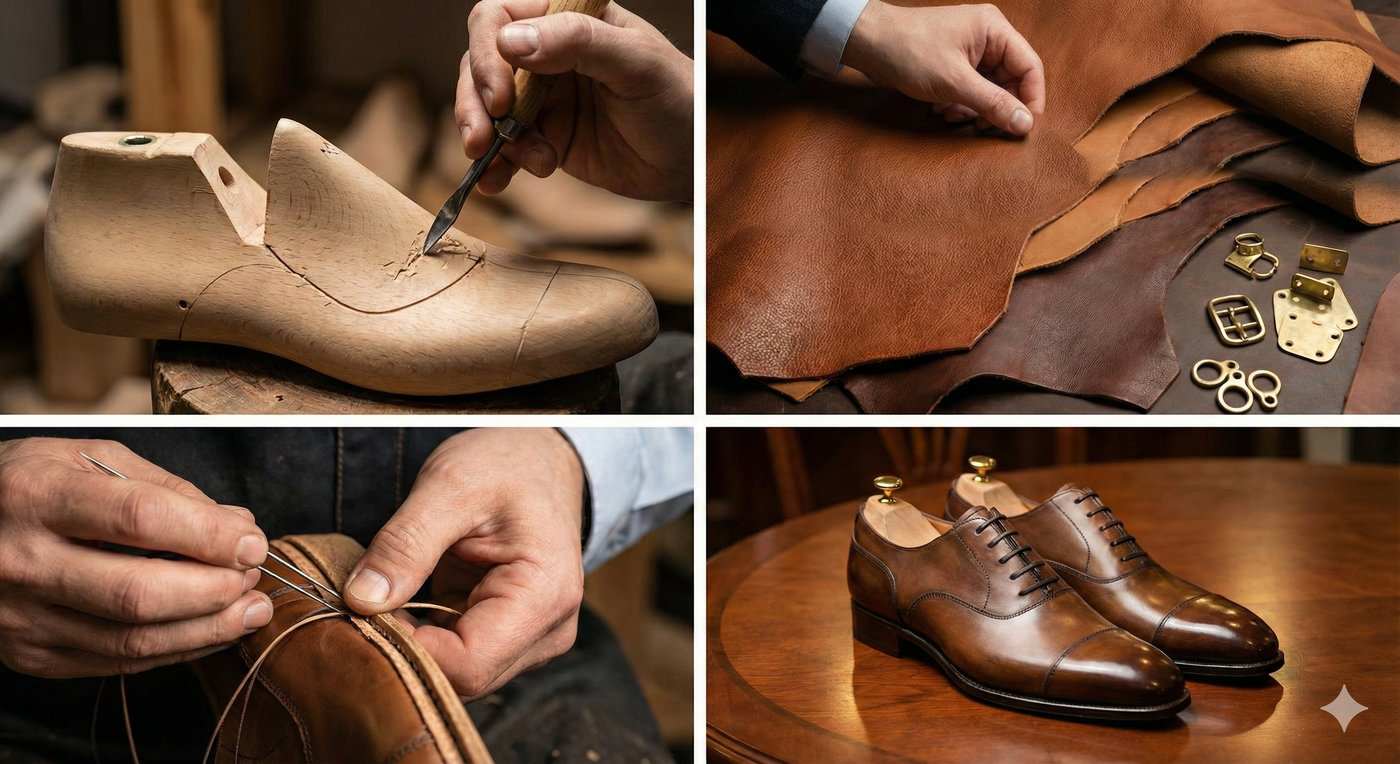
When a customer sees the price of handmade shoes, the first question is almost always the same: why are they so expensive? Shoes in a store cost $100-200, and custom orders start at $500. The difference seems illogical until you look behind the scenes of production. At Vicelli, we practice complete pricing transparency and are ready to explain exactly what you are paying for when ordering handmade shoes.
Manual labor vs. assembly line: what the numbers say
Factory shoes are produced on automated lines, where one pair is assembled in 15-20 minutes. Machines perform 80-90% of operations: cut out parts, glue them, sew on the sole. A person only controls the process and performs the final finishing. Such mass production allows to reduce the cost to a minimum.
Custom-made shoes take 30 to 60 hours of work by a skilled craftsman. Each operation is performed manually: from taking measurements and creating an individual insole to the final polishing. For one pair of Goodyear Welted shoes, the master Vicelli takes about 40 hours of pure work, spread over 4-6 weeks, taking into account technological pauses for drying the glue, impregnation of the leather and other processes.
A specific example of time costs:
- Consultation and measurement: 1-1.5 hours
- Sketch creation and approval: 2-3 hours
- Pad preparation (if new one is needed): 4-6 hours
- Skin cutting taking into account individual characteristics: 2-3 hours
- Sewing the shoe upper: 8-12 hours
- Shoe shaping on the block: 6-8 hours
- Sole attachment (Goodyear Welted): 4-6 hours
- Finishing, polishing, quality control: 3-4 hours
Even if you calculate the minimum hourly rate of a qualified craftsman ($20-30 in Europe), the work alone costs $600-900. And that’s without the cost of materials.
Materials: leather from Italian tanneries vs Chinese fakes
Factory shoes often use corrected grain leather, a material with imperfections that is sanded and coated with a polymer layer. This leather looks perfectly smooth, but it doesn’t breathe, cracks easily, and lacks natural elasticity. The cost is $3-8 per square foot.
At Vicelli we work with full grain leather – full-grain, of the highest quality. This is the top layer of leather without sanding, with a natural texture and pattern. Such leather breathes, takes the shape of the foot, and lasts for decades. Suppliers are proven tanneries (tanneries) in Italy, France, and Spain with centuries-old traditions.
Cost of materials for one pair:
- Full grain calfskin (Italy): $80-150 per skin (about 2.5-3 sq. ft. is needed for a pair of shoes, i.e. $30-50)
- Lining leather (soft pigskin or calfskin): $15-25
- Premium leather sole (tanned oak): $20-35
- Heels, heel caps, accessories (blocks, laces): $10-20
- Glues, waxes, professional threads: $5-10
The total materials for classic shoes are $80-140. For shoes made of exotic leather (python, crocodile), the leather itself costs $200-600.
Cheap factory shoes for $100 physically cannot use high-quality leather – the materials would eat up the entire budget. Therefore, composite materials, leather substitutes, or low-grade leather are used.
Individual block: the secret to a perfect fit
Standard shoes are made on typical insoles designed for the “average” foot. But in reality, each foot is unique: toe length, instep height, heel width, angle of inclination – everything is individual. Therefore, mass-produced shoes never fit perfectly: they are tight in some places, loose in others.
At Vicelli, we take up to 15 measurements of each foot and create or adapt a custom insole. This is a wooden or plastic mold that precisely replicates the anatomy of your foot, taking into account all its features.
The cost of an individual insole: $150-300 per pair. It remains in the workshop and is used for all subsequent orders of the client. That is, it is a one-time investment – the second and subsequent pairs of shoes will be cheaper.
For factory production, individual pads are economically impossible. Creating a pad for each customer with production volumes of thousands of pairs is simply unrealistic.
Sewing Techniques: Goodyear Welted vs. Glue Method
Most factory shoes are assembled using the cemented construction method: the upper is glued to the sole. It is fast, cheap, but short-lived. After a year of wearing, the glue loses its properties, the sole peels off, and the shoe goes to the trash. It is almost impossible to repair such shoes.
Handmade shoes are sewn using classic techniques:
Goodyear Welted is the most popular method. The upper of the shoe is sewn to a welt, which is then sewn to the sole. This creates a strong joint that can be disassembled and the sole replaced 8-10 times over the life of the shoe.
Blake Stitch – the sole is sewn directly to the upper with a single stitch. Lighter and more flexible than Goodyear, but less resistant to moisture.
Norwegian Welted is an expanded version of Goodyear for winter shoes, with additional water protection.
Hand Welted is the most complex and expensive technique, where all seams are made by hand. It is used for the most premium models.
These techniques require special tools, skills, and time. One Goodyear Welted welt stitch takes 2-3 hours to complete. But the result is a shoe that lasts 20-30 years and can be repaired multiple times.
Repairability: Lifetime value
Factory shoes are thrown away after the sole wears out. The adhesive connection does not allow replacing the sole without destroying the entire structure. Even if the upper is in perfect condition, the shoes are “disposable”.
Handmade shoes using Goodyear Welted technology can be restored an unlimited number of times:
- Sole replacement: $80-120, shoes look like new
- Heel and toe replacement: $30-50
- Top restoration (painting, removing scratches): $50-100
- Lining replacement: $60-90
Vicelli has customers who have been wearing their shoes for 15+ years. During this time, the shoes undergo 3-4 sole replacements, the color and texture of the leather are updated several times. But the basic design remains the same.
Long-term cost comparison:
Factory shoes $150 x 10 pairs over 20 years = $1500 Handmade shoes $600 + restoration $400 over 20 years = $1000
Custom shoes are not only better quality, but also more economical in the long run.
Unique design: your ideas, our implementation
Mass production is limited to a few dozen models per season. The choice is limited to a collection that designers have prepared in advance. If you want something unique, you will have to search among thousands of options and, most likely, you will not find the perfect one.
Custom-made shoes mean complete freedom:
- Model: from classic oxfords to avant-garde shoes with a unique cut
- Color: any shade, including patination (smooth color transitions)
- Material: combinations of leathers of different textures, exotic inserts, contrasting elements
- Details: toe shape, lacing type, accessories, decorative stitching
At Vicelli, every project starts with a consultation, where we discuss your style, wearing occasions, and wishes. Our craftsmen create sketches, suggest options, and take your comments into account. The result is shoes that no one else has.
Production time: why can’t it be faster?
Mass production is optimized for speed. The assembly line runs 24/7, a batch of 1000 pairs is produced in a week. Ordered today – shoes in your store in three days.
An individual order requires time at each stage:
- Preparation of materials: 3-5 days (leather order, delivery)
- Sewing the top: 5-7 days (including drying after molding)
- Sole attachment: 3-5 days (technological pauses between stages)
- Final finishing: 2-3 days
The general term at Vicelli is 4-6 weeks. These are not delays, but technological requirements. For example, after gluing the welt strip, the shoe must “rest” for 48 hours so that the glue gains strength. Accelerating this process will degrade the quality.
For exotic leather or complex projects, the time can increase to 8-10 weeks. Every detail is made with the utmost attention – you can’t sew day and night without losing quality.
Service and warranties: full responsibility of the master
When you buy factory shoes, you get a standard 3-6 month warranty against manufacturing defects. After that, the shoes are your problem. If the sole is worn out, buy a new one.
At Vicelli we provide:
- Warranty on materials and labor: 12 months
- Free fit adjustment: within the first month of wearing if there is any pressure
- Priority service: our customers always have priority when booking repairs
- Care consultations: we teach you how to properly care for your specific shoe type
- Lifetime support: even after 10 years, we are ready to restore your shoes
We take full responsibility for every pair that leaves our workshop. This is not an anonymous factory where no one is responsible for the result. At Vicelli, each craftsman puts a personal mark on the shoes – it is a matter of professional dignity.
Invisible costs: workshop infrastructure
Behind the scenes of prices are investments that the customer does not see, but which directly affect quality:
Equipment: professional leather sewing machines, welting press, blocks of various sizes, hand tools. The initial cost of workshop equipment is $50,000-100,000.
Master training: a qualified shoemaker studies for 3-5 years. Vicelli employs specialists with European experience and certificates from leading shoemaking schools.
Space: The workshop must maintain a certain temperature and humidity for storing leather. The costs of renting and maintaining a specialized space are significant.
Logistics: import of materials from Europe, certification of exotic leather, customs payments – all this is included in the cost.
Mass production amortizes these costs over thousands of pairs. An individual atelier amortizes them over dozens of orders per month. Therefore, the share of overhead costs in the price of one pair is much higher.
Psychological value: an investment in confidence
In addition to material factors, there is a psychological aspect that is difficult to estimate in terms of money. Shoes created especially for you, which fit perfectly, emphasize your individuality – this is confidence in every step.
At Vicelli, customers tell us how custom shoes have changed the way they feel about themselves. When you know you’re wearing something unique, handcrafted from the finest materials, you feel different. It’s not a waste, it’s an investment in your image and self-esteem.
For businessmen , individual shoes are part of a professional image. People notice details during negotiations. High-quality shoes signal attention to quality, success, and respect for oneself and others.
For creative professions , it is an opportunity for self-expression. Unique design, non-standard solutions, exotic materials become part of a personal brand.
Fair price: what is included in the price
Let’s summarize the components of the price of custom-made shoes at Vicelli:
- Premium materials: 15-20%
- Master’s work (30-60 hours): 40-50%
- Individual pad (for first order): 10-15%
- Overhead costs (equipment, rent, training): 15-20%
- Service and warranties: 5-10%
- Uniqueness of design and consultation: 5-10%
No excessive markups. Every dollar is justified by the real costs of creating the highest quality shoes.
Compared to mass-produced branded shoes ($300-800), where you pay mostly for the logo and marketing, custom order is a fair price for real value.
An investment that pays off
Custom shoes are not a waste, but an investment in long-term quality, comfort, and individuality. When you calculate the cost over years of use, you will see that custom shoes are often more cost-effective than cheap alternatives that have to be replaced every year.
At Vicelli, we create shoes that accompany you through the most important stages of life: weddings, career milestones, personal celebrations. Shoes that you will wear for years with pride and pleasure.
Book a consultation with Vicelli – we will explain the creation process in detail, show you the materials, discuss the budget and create shoes that will justify every dollar spent. Quality has its price, but it is worth it.